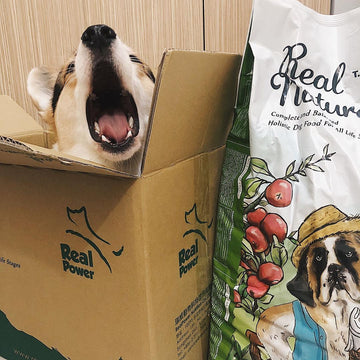
Pet Food Myth Busters #3 – Is SODIUM bad for dogs?
What You Should Know About Sodium
Sodium is a macromineral, meaning dogs need it in larger amounts than trace minerals. Together with potassium, sodium functions as an important electrolyte, helping the body with:
-
Regulating blood pH (dogs need pH ~7.3–7.4)
-
Maintaining proper fluid balance in and between cells
-
Supporting nerve and muscle function
-
Enabling nutrient absorption and transportation
-
Assisting kidney and urinary function
-
Activating key enzyme processes
Because of these critical functions, a low-sodium diet is not recommended for healthy dogs unless advised by a veterinarian.
Sodium in Pet Food: It's All About Balance
At Real Power, our nutritionists calculate each formula’s dietary electrolyte balance (dEB) using the following formula:
ナトリウム(Na+)+カリウム(K+)―塩化物(Cl-)(単位:mEq/kg)
Normally the dEB value falls between 100-400 mEq/kg in terms of dog. If the dEB strays too far outside this range, it can lead to:
-
Poor nutrient absorption
-
Shrinking of intestinal villi
-
Diarrhea
-
Abnormal blood pH
-
Decreased bone density
Studies even suggest that a well-balanced dEB can help delay or ease hip dysplasia—another reason why sodium, potassium, and chloride must all be considered together.
So... Shoule Pet Food Be Low in Sodium?
Not necessarily.
Regarding sodium content for each of our Real Nature Recipe dog food, it may vary depend on different meat and amount used in each formula, which normally fall between 0.3-0.4%.
The sodium level in pet food depends largely on meat content. The more meat or seafood used, the higher the natural sodium content, especially with ingredients like salmon or scallop. And since we don’t add salt to Real Power formulas, the sodium you see is 100% from natural sources.
Typical Sodium Ranges in Real Power Dog Food:
| Recipe Name | Sodium Content |
| NO 1. PRAIRE Lamb | 0.28-0.35% |
| NO 2. FOREST Chicken | 0.29-0.35% |
| NO 3. OCEAN Salmon | 0.30-0.40% |
| NO 4. RIVER Duck | 0.30-0.35% |
| NO 5. LAKE Turtle | 0.35-0.40% |
*Note: Actual levels may vary slightly due to seasonal or natural variations in meat sources.
As sodium plays such an important role in body health, it should not be too low when it comes to functional dog food that designed for better nutrient absorption and intestinal health. Also, because of the natural sodium in meat, it is not possible for a high-in-meat pet food to have very low sodium content.
Here are some common cases for reference.
- 中~低価格帯のペットフード:トウモロコシ50%、通常のチキンミール30%の配合で、食塩無添加でナトリウムは0.12%程度です。 より低いナトリウム量(例えば0.09%)を探しているなら、この場合は植物性原料をより多くするか、肉を少なくするなどの調整が必要となり、高品質なペットフードを追求する飼い主様には適さない製品と言えるでしょう。
- ホリスティックペットフード:乾燥鶏肉を50%、植物性原料(例えばトウモロコシやその他の非穀物)を20%~30%使用した配合で、そのナトリウムは少なくとも0.25%です。もし天然魚やホタテを加えた場合、ナトリウムは0.4%を超える可能性があります。
どのブランドをお選びになられたとしても、ナトリウムの含有量は最大摂取量の1.5%以下である必要があります。
What About Low-Sodium Diets?
If your dog has health concerns like heart, liver, or kidney disease, your vet might recommend temporarily reducing sodium. But once their condition stabilizes, moderate sodium intake is needed to maintain proper fluid and metabolic balance.
In general, most high-quality pet foods are formulated to be complete, balanced, and safe for daily feeding, including appropriate sodium levels.
Final Thoughts: Don't Fear Sodium
Sodium is not something to avoid—it’s something to understand.
Unless specifically advised by your vet, cutting sodium too low can harm your dog’s long-term health. That’s why at Real Power, we don’t add extra salt, and instead rely on natural meat-based sodium to keep your dog healthy and happy.
参考文献
Sodium for Dogs (wagwalking.com)
Feeding the Cardiac Patient (vermontveterinarycardiology.com)